
From Rugby School to the World Stage: The Evolution of Rugby from 1823 to Today
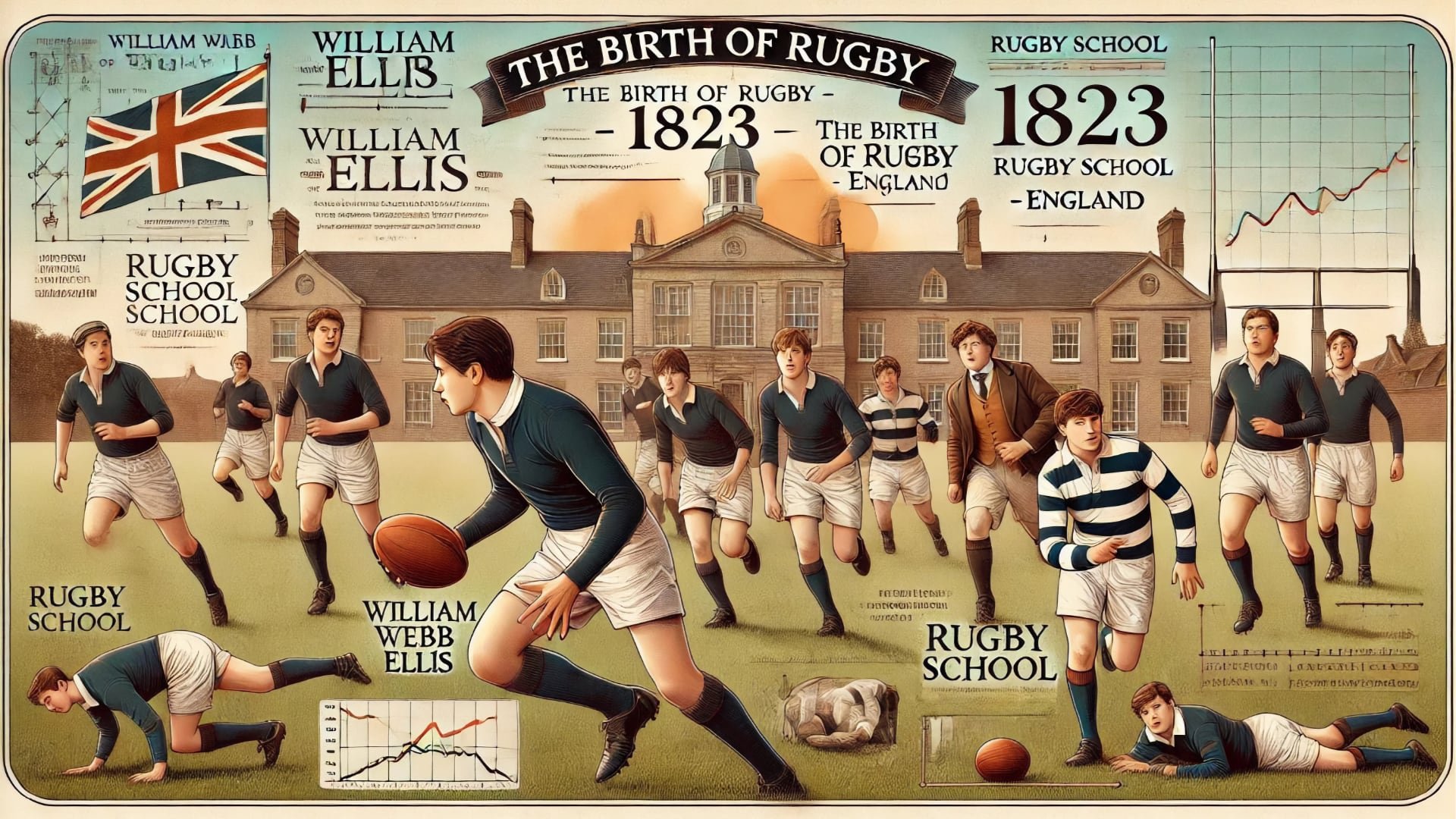
Image created with AI
In 1823, during a spirited football match at Rugby School in England, a young student named William Webb Ellis, driven by a flash of inspiration, picked up the ball and ran towards the opposition's goal. This audacious act is celebrated as the inception of rugby football, a sport that has since evolved into a global phenomenon. (World Rugby)
Early Development and Codification
Following Webb Ellis's legendary run, the game gained popularity among public schools in England. The first set of written rules was established in 1845 by the pupils of Rugby School, providing a formal structure to the sport. As the game's appeal grew, disputes over rules led to the formation of the Rugby Football Union (RFU) in 1871, aiming to standardise the laws of the game. (Wikipedia)
The Great Schism: Union and League
The late 19th century saw tensions rise over the issue of professionalism. In 1895, disagreements about player compensation led to a split, with 21 clubs in Northern England forming the Northern Rugby Football Union, later known as rugby league. This division resulted in two distinct codes: rugby union, which remained amateur until 1995, and rugby league, which embraced professionalism earlier. (Wikipedia)
Global Expansion and Milestones
Rugby rapidly expanded beyond the British Isles. The first international match was played between Scotland and England in 1871, marking the beginning of international competition. The sport's inclusion in the Olympic Games in the early 20th century further showcased its global appeal. However, it wasn't until 1987 that the inaugural Rugby World Cup was held, co-hosted by Australia and New Zealand, solidifying rugby's place on the world stage. (Wikipedia)
The Emergence of Rugby Sevens
Rugby sevens, a faster-paced variant with seven players per side, originated in Melrose, Scotland, in 1883. This format gained popularity due to its dynamic and spectator-friendly nature. The first officially sanctioned international sevens tournament took place at Murrayfield in 1973, celebrating the Scottish Rugby Union's centenary. Rugby sevens made its Olympic debut at the 2016 Rio de Janeiro Games, marking rugby's return to the Olympics after a 92-year absence. Fiji's men's team and Australia's women's team made history by winning the first-ever Olympic gold medals in rugby sevens. (World Rugby)
Modern Era and Professionalism
The year 1995 marked a significant turning point as rugby union embraced professionalism, allowing players to be compensated for their talents. This shift led to increased competitiveness, enhanced training methodologies, and a broader global audience. Today, rugby stands as a testament to tradition and innovation, captivating millions worldwide with its rich history and dynamic evolution.
For a visual journey through rugby's storied past, explore the following video: